
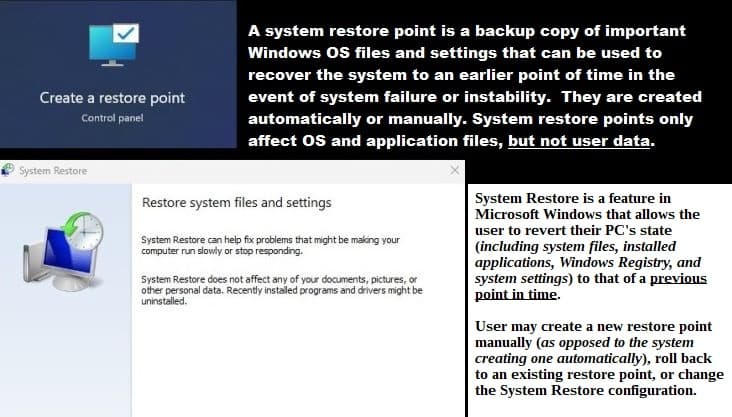
System Restore, creating Restore Points, and restoring your Windows PC

Sometimes, PCs fail—for whatever reasons ‘n users want their PCs back in working order as quickly as possible. The problem may have been caused by the user, OEM, software, new or broke hardware, and in very rare cases—the Windows OS itself.

From my experience, PC OEMs have usually been the problem, especially wid their added OEM software, and a Lenovo desktop computer was the most troublesome computer I’ve ever owned. When Windows Vista came out (1/30/2007) one could find incredible bargain prices on new Vista PCs, and I purchased three different ones at that time—that troublesome Lenovo desktop was one. Finally got that Lenovo working right by just wiping out the OS drive and doing a completely new installation of Vista on it – without any of their OEM software.

Windows 10 & 11 provide at least three easy solutions to most of the PC problems that users come across, and I am on #2 wid this post – #1 was Backup and Restore (Windows 7) ‘n #3 will be Reset PC. I’ll be linking to each one in the future as I finish ‘n post them.

Truthfully, I have never had any issues wid either Windows 10 Pro or Windows 11 Pro, on the desktop computers I have built – ‘Build Your Own Computer’ (BYOC). I recently had an issue wid my Dell XPS 13 9310, the Dell SupportAssist wasn’t working right, and that is the reason I came up wid the idea for these three posts. 19-months without any issues, but then a SupportAssist issue the other day.

Read more

Backup and Restore (Windows 7) – a utility for your Windows 10 or 11 PC

This post is on how to do a full Backup and Restore of your Windows 10/11 PC, using a backup system image you created, and then restore that backup image to a new drive – maybe your PC’s drive crashed or you moved to a bigger drive.

Am planning two more similar posts – 1) Configuring System Restore ‘n then creating restore points which can be used later, if something you added or an update went wrong, to restore your PC back to a point before something went wrong. 2) Reset PClets you perform a clean reinstallation and update of Windows while keeping your personal data and most Windows settings intact. In some cases, a clean installation may improve your device’s performance, security, browsing experience, and battery life‘. ‘Sorta‘ a series…so to speak. 🙂

Create a backup System Image

Read more

“Meet the Techs of Tomorrow Where They Are Today” — by Ankush Das

I’ve been piddling wid Linux since 1996, and even tho Win11 Pro is my primary OS I still enjoy piddling wid, testing, and learning about Linux. In this modern world most of us already use 2-3 OSes – maybe without even knowing it, so checking out one more OS isn’t going to be that difficult, IMHO. 👏👍👌🙂

It’s FOSS has a great article by Ankush Das“Meet the Techs of Tomorrow Where They Are Today”: A Conversation With Stu Keroff:

Read more

SanDisk Extreme PRO® USB – ‘Fastest USB I’ve ever owned’

Am no expert USB ‘Techie‘ but I do know what ‘Desktop Duty‘ is — it is the performance I expect from ‘My Computers‘, other hardware, my OS, and other software (to a lesser degree).

When I transfer a 4.46 GB Redcore.Linux.Hardened.2301.Sirius.KDE.amd64.iso from a download folder to a 128 GB USB (NTFS format), I don’t like waiting for 2-3 minutes – or more in some cases. Here’s an example of the different Write speeds between a 128 GB SanDisk Ultra and a 128 GB SanDisk Extreme PRO®:

Read more

Ubuntu Cinnamon 23.04 – ‘just another Linux Enterprise OS’

This Ubuntu Cinnamon 23.04 review will explore whether Ubuntu is posing as a Desktop OS for average users. I hate OSes that slow down my workflow wid annoying “Authenticate” popups, and Ubuntu Cinnamon 23.04 “Lunar Lobster” is just another Linux Enterprise OS posing as a Personal Computer (PC) OS.

A personal computer (PC) is a multi-purpose microcomputer whose size, capabilities, and price make it feasible for individual use. Personal computers are intended to be operated directly by an end user, rather than by a computer expert or technician. Unlike large, costly minicomputers and mainframes, time-sharing by many people at the same time is not used with personal computers. Primarily in the late 1970s and 1980s, the term home computer was also used.

Chromebooks’ Chrome OS doesn’t have annoying “Authenticate” popups, my Computers wid Win11 Pro don’t have annoying “Authenticate” popups, and my Android phone doesn’t have annoying “Authenticate” popups. All more secure than the Linux Open-Source operating system/s.

Read more

Translate »