
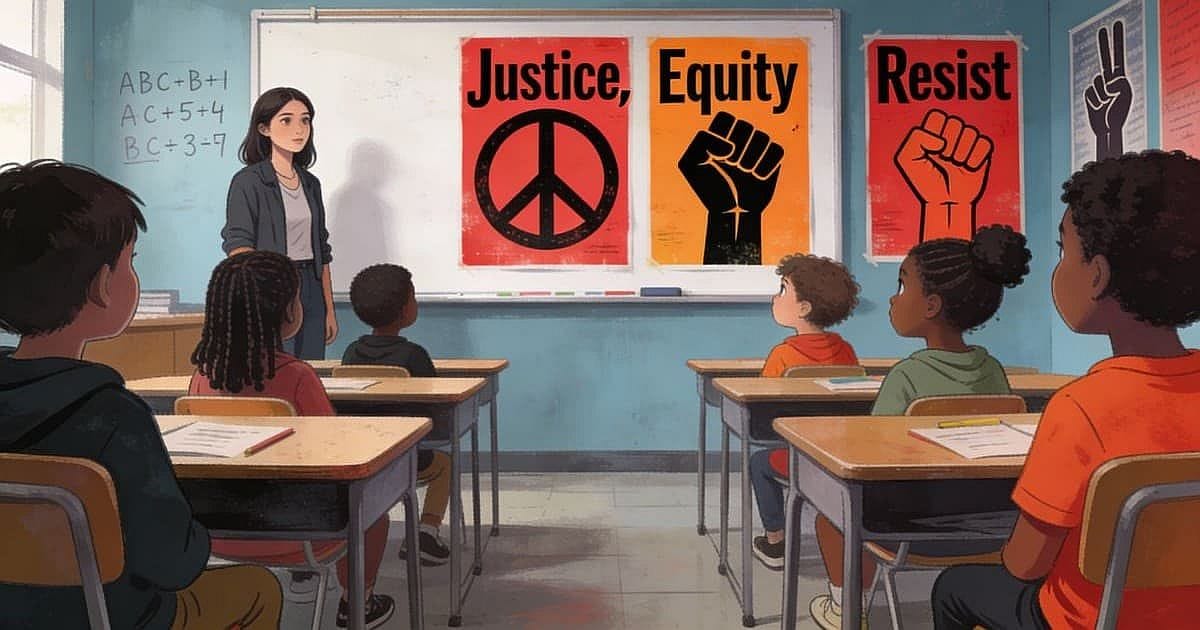
K–5 charter schools sound harmless until you see a mother choose a school that advertises her six‑year‑old will be raised with “social justice first” instead of reading, writing, and arithmetic. When that same mother is anti‑ICE “warrior” Renee Nicole Good, shot dead in a street confrontation with a federal agent, the lesson plan stops being theoretical and starts colliding with the law.
Social Justice has become a marketing slogan for K–5 charter schools that promise activism, equity, and “critical thinking” long before kids can reliably read a full page on their own. When Renee Nicole Good proudly put her six‑year‑old into a school that boasts it puts “social justice first,” she turned her family into a live‑action case study of what happens when Social Justice lessons grow up and run straight into badges, guns, and traffic laws.
K–5 Charter Schools and Social Justice
K–5 charter schools like Southside Family Charter School wrap Social Justice into their mission statements with promises of “critical thinking,” “political and social activism,” and “advocating for children and families.” On paper it sounds noble, but when a school openly centers Social Justice for five‑ to eleven‑year‑olds before they have strong reading, writing, and math skills, it tells you what the adults value most in that classroom.
Globally, the U.S. does not dominate the basics the way it dominates the culture war. In the most recent PISA tests of 15‑year‑olds, American students scored about average in mathematics, while other education systems outperformed them by wide margins. Even in reading and science, where U.S. scores are slightly above the international average, countries like Singapore, Korea, and Japan still leave American students behind.
So when a K–5 charter school advertises Social Justice, political activism, and equity work as the center of its mission, it is doing that on top of a system where too many kids still struggle with basic math and literacy. Turning elementary classrooms into training grounds for causes instead of locking down fundamentals looks a lot less noble once you remember how far American students already lag behind the top performers in the world.
From Social Justice Lessons to Street Activism
Renee Nicole Good was not just a Minneapolis mom; she was part of an “ICE Watch” network that trained activists on how to monitor and resist federal immigration enforcement. Media accounts and sympathetic organizers describe her as a “warrior” who believed confronting ICE in the street was a moral duty, not a fringe hobby.
On the day she died, Good had just dropped her six‑year‑old son at the social‑justice charter school before joining a planned confrontation with ICE on a Minneapolis street. Video and official descriptions show vehicles stopped in the roadway, cameras rolling, and Good positioning herself between the agent’s car and the open lane while her allies filmed the encounter.
Protest Rights vs. Breaking the Law
Minnesota, like every state, protects the right to protest in public spaces, but that right does not include shutting down traffic whenever a cause feels urgent. Even the ACLU’s own protest guide for Minnesota admits that a protest which blocks vehicular or pedestrian traffic without a permit is illegal and exposes people to arrest, no matter how passionate the message is.
State law goes further when officers are on scene. Minnesota Statute 609.50 makes it a crime to “obstruct, resist, or interfere” with a peace officer who is performing official duties. The same statute lets prosecutors bump the charge up to a felony if the conduct creates a risk of death or serious bodily harm.
Criminal defense attorneys in Minnesota spell this out with very simple examples. Standing in the way of an officer, ignoring lawful commands, or physically blocking a vehicle can all be treated as obstruction of legal process, not “peaceful protest.”
When Social Justice Meets the Law
When Social Justice education leaves the safety of the classroom and spills into the street, the grading rubric changes from feelings to force. A mother who sends her child to a “social justice first” charter school and spends her free time confronting ICE in traffic is no longer just debating ideas; she is testing her ideology against statutes, squad cars, and officers with lethal authority.
Renee Nicole Good’s confrontation with an ICE agent did not happen in a vacuum. It followed years of Social Justice messaging that paints law enforcement as an enemy to be blocked, filmed, and “resisted,” instead of as an authority with the power to arrest or shoot when things go sideways.
When Social Justice tells activists that disrupting traffic and surrounding officers is “doing what’s right,” it skips the part where metal, momentum, and human fear can collide in the middle of the road.
Outro
When a mother decides that Social Justice activism comes before the three R’s, before basic manners, and before teaching a six‑year‑old to respect the law, that choice lands on the child long after she is gone. Teaching a first‑grader that “resisting” police and immigration officers matters more than learning to read, write, and sit still in class starts to look less like virtue and more like moral negligence.
Southside Family Charter School and its peers are not neutral in that equation; they sign up to be institutional partners in turning elementary classrooms into training camps for street politics instead of places where children master the basics they actually need. Their “social justice first” branding tells parents exactly where academics rank on the priority list.
The Progressive fantasy that blocking traffic is “speech” instead of intimidation ignores what it feels like to be trapped in a car with kids while strangers pound on the doors and windshield. Most drivers are not looking for a fight; they are trying to get home without becoming internet content or a courtroom defendant.
Yet again and again, panicked motorists find themselves charged while professional protesters treat highways and city streets as their private stage. They gamble with everybody else’s safety as if it were free, confident that video clips and sympathetic headlines will cover the tab.
Renee Nicole Good chose that culture when she signed her son into a “social justice first” school and then drove into a street confrontation with a federal agent. She was not ambushed on a sidewalk; she drove into a situation built on the belief that her cause outranked everybody else’s safety and the law’s clear limits.
In the end, she fought the law the same way she had been taught to fight ICE and border enforcement, and the law did what it always does when ideology collides with metal, fear, and momentum in the middle of the street.
No wonder Rebecca – Good’s spouse – later blamed herself for Good’s death:
“I made her come down here; it’s my fault,” Rebecca said, her face covered in blood after having attempted to help Renee. “They just shot my wife.”
Similar Topics: