
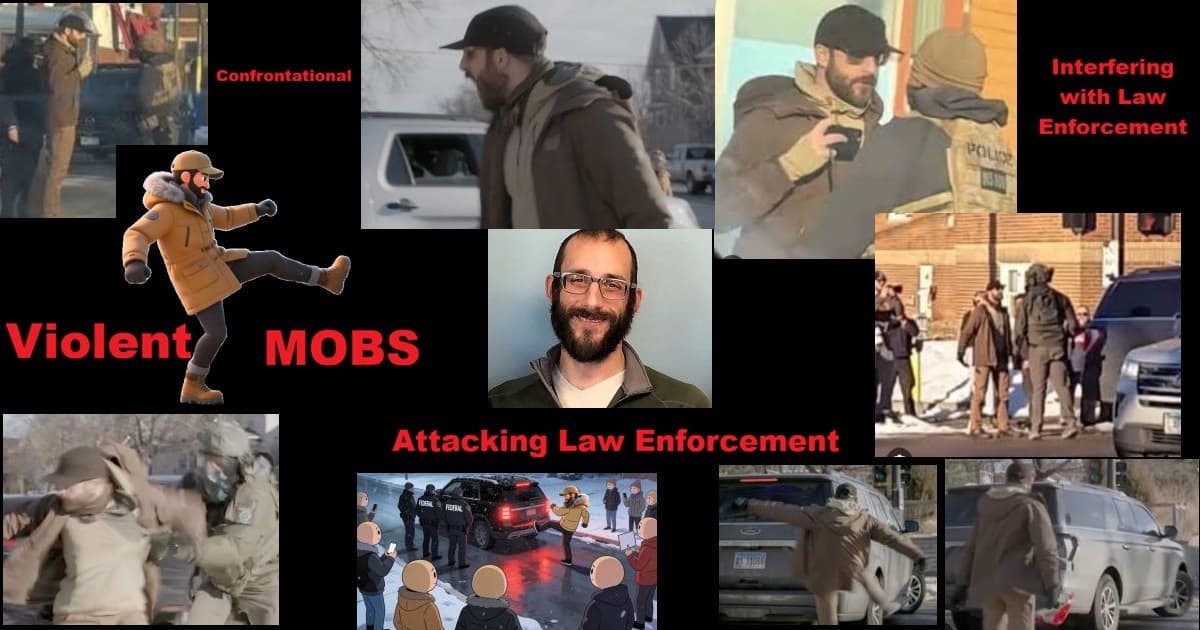
Violent mobs did not just “happen” around Alex Pretti; he chose to stand with them, train with their tactics, and help create the chaos that ended in his own death. Agents were trying to do their jobs, and ordinary drivers were just trying to get their kids home, when those violent mobs once again turned public streets into a weaponized stage for confrontation and fear.
Once you strip away the media spin and political excuses, you see the same pattern of violent mobs playing out over and over again—blocking roads, swarming cars, getting in people’s faces, and daring them to react in ways that can ruin lives. This post is about putting responsibility back where it belongs: on Alex Pretti, on the violent mobs he joined, and on the organizers and enablers who keep training people to manufacture these deadly showdowns.
Violent mobs are not an accident of modern politics; they are the intended product of organizers, trainers, and political cheerleaders who treat other people’s lives as expendable props. While the media works overtime to polish Alex Pretti’s image, they rarely admit that he kept inserting himself into these violent mobs, bringing a pistol and extra magazines into the same streets where moms were trapped in cars with their kids.
How Violent Mobs Created the Alex Pretti Tragedy
The Alex Pretti story did not start with a gentle nurse quietly walking down the street; it started with a man who repeatedly chose to stand shoulder‑to‑shoulder with violent mobs. On January 13, video shows him in Minneapolis screaming at federal immigration agents, spitting toward them, and then kicking the rear of their SUV hard enough to shatter a taillight as they tried to leave.
Agents responded by rushing him, tackling him to the ground, and using force to restrain him in the middle of a tense crowd, and that was his first clear signal that this path was dangerous. Instead of backing away from violent mobs after that encounter, he came back for more.
By January 24, he was again in the thick of things at another anti‑ICE operation, this time with a semiautomatic pistol and extra magazines on his body. He physically inserted himself into an active enforcement scene, stepped into an officer’s space as women were being shoved, and then resisted hard when agents tried to arrest him in the street.
Those final seconds are now the subject of investigations and endless debate. But the larger truth is simpler: no matter what you think about the shots themselves, Alex Pretti made choice after choice to align with violent mobs and bring a loaded weapon into their chaos, and that is how his tragedy was created.
Violent Mobs vs. Innocent Drivers and Families
Violent mobs don’t just scream slogans; they turn roads and intersections into traps for people who never chose to be part of their stunt. Over and over, drivers—often women with children in the back seat—suddenly find their vehicles surrounded, with people pounding on the hood and blocking every lane.
In that moment, a minivan full of kids becomes a cage, and the mother at the wheel is forced into the most primitive calculation there is: fight or flight to keep her children alive.
Sometimes those mothers hit the gas and end up driving through the crowd, injuring people to break free. The same media that excuses the street chaos then turns around and paints the terrified driver as the villain, while still calling the violent mobs “mostly peaceful.”
That upside‑down narrative is exactly backwards. When an organized group decides to flood into the street, block every exit, and menacingly surround cars, they are the ones creating the deadly risk. Ordinary families are just trying to get out alive.
The Protest Industry Training Violent Mobs
Violent mobs don’t come out of nowhere; they are the end product of organizers and trainers who deliberately teach people how to shut down roads, block entrances, and overwhelm public spaces. Under the nice label of “direct action,” they run workshops on how to form human roadblocks, how to “hold” intersections, and how to keep pressure on police and drivers without breaking ranks.
They know exactly what happens when you trap strangers’ cars and pack bodies into busy streets: fear spikes, tempers flare, and the odds of someone getting hurt go way up. They keep doing it anyway, because the spectacle and disruption are the point.
A whole cottage industry has grown up around this, with toolkits, activist handbooks, and online guides that walk recruits through disruptive tactics step by step. Instead of telling people to stay on sidewalks and avoid trapping vehicles, they celebrate “shutting it down” as a badge of honor. The result is not some organic outburst, but a repeating pattern of violent mobs using the same tactics city after city, knowing full well that innocent people and bystanders are going to get caught in the crossfire.
When Alex Pretti plugged himself into that world, he wasn’t just wandering into a random crowd; he was joining a protest machine that treats other people’s safety as collateral damage.
When You Choose the Fire, You Own the Burn
From the start, this was not a story about a quiet nurse suddenly ambushed by power‑mad agents. It was a story about a man who kept walking back into the fire, shoulder‑to‑shoulder with street mobs he knew were confrontational and volatile. After the first clash, he knew exactly how ugly these confrontations could get, and he still chose to return. That was not bad luck; that was a pattern.
Bringing a loaded pistol and spare magazines into that environment took it to a different level. It meant every shove, every scream, and every scuffle carried the risk that a weapon could come into play in the middle of a packed crowd.
When someone like that resists arrest in the street, in the middle of a mob, it does not just endanger him; it endangers every person within range of that gun if it goes off or gets grabbed. That is why so many people see his death as the predictable endpoint of his own choices, not an inexplicable bolt from the blue.
Human nature is brutally simple in those moments. Box people in, scream in their faces, rattle their car doors, or pile on them in a moving crowd, and you will trigger fight‑or‑flight instincts they cannot simply switch off. Sometimes that means an officer fires, sometimes it means a driver floors it, and sometimes it means an armed protester tries to stand his ground when he should have walked away.
Either way, the spark is the same: someone decided their “cause” justified invading other people’s space and forcing them into a life‑or‑death calculation they never asked for.
If we’re serious about stopping this cycle, we have to treat that decision—the decision to build and join these confrontational street operations—as deadly serious in its own right.
That means tougher laws for organized road‑blocking, harsher penalties when people are injured or killed, and zero patience for politicians or media who keep pretending this is just noisy free speech. It means telling the uncomfortable truth: when you help create the conditions for chaos with trained street tactics, and people die, you don’t get to shrug and point the finger somewhere else.
Media and Politicians Running Cover
The protest industry doesn’t operate in a vacuum; it runs on cover from friendly media and politicians who will excuse almost anything as “mostly peaceful.” Night after night, people watch footage of roads blocked, cars surrounded, businesses smashed, and officers swarmed, and then hear anchors insist it was “largely calm” or “just passionate dissent.”
That constant spin tells activists there will always be someone on TV ready to reframe their intimidation and street chaos as noble activism. It also tells the rest of us that our fear and anger don’t count.
On the political side, the pattern is just as obvious. The same leaders who preach “democracy” and “norms” race to the cameras to defend road‑blocking and intersection takeovers as legitimate speech, then attack any attempt to protect drivers or stiffen penalties as an assault on civil rights.
When lawmakers try to shield motorists who hit protesters while fleeing a crowd, these politicians call it “legalizing murder” instead of admitting that trapping people in their cars is itself a form of violence. That kind of rhetoric isn’t neutral; it rewards the most aggressive tactics and dares police and drivers to swallow whatever comes at them.
In practical terms, that means every organizer planning the next shutdown knows two things. First, sympathetic media will highlight the nicest signs and the calmest moments while burying the fear, damage, and injuries. Second, their favorite politicians will blame any bloodshed on “overreaction” from law enforcement or terrified drivers, never on the people who built the street confrontation in the first place.
That is how a whole ecosystem grows up around this behavior, constantly reassuring agitators that someone else will take the heat for the consequences.
Holding Violent Mobs and Their Enablers Fully Responsible
None of this excuses every bad decision any agent has ever made, but it does put the spotlight back where it belongs. Alex Pretti was not a random passerby; he was a repeat participant who chose to stand with violent mobs, escalate confrontations, and bring a loaded pistol into the middle of their chaos.
The road‑blocking crowds are not “community gatherings”; they are deliberate pressure tactics that terrorize drivers, endanger children, and force ordinary people into fight‑or‑flight choices they never wanted.
The organizers who design these shutdowns, the trainers who coach people on how to block streets and swarm cars, and the politicians and media who keep excusing it all are part of the same chain. They light the fuse, then pretend to be shocked when something explodes.
If there is any hope of preventing the next tragedy, it starts with saying out loud that violent mobs and the people who empower them bear a heavy share of the blame—and refusing to let them hide behind pretty slogans and sanitized narratives ever again.
When Leaders Call It What It Is
For years, Donald Trump has warned that the people funding, training, and directing these street operations are not just noisy activists, but something closer to a domestic wrecking crew.
He has blasted the back‑room funders and political allies of these campaigns as “treasonous” and “insurrectionist” not in the narrow legal sense, but in the plain‑language sense of betraying their own citizens by unleashing chaos on American streets. When you look at the pattern—organized shutdowns, repeat riots, drivers and officers told to just take it—it’s hard to say he’s wrong about the scale of that betrayal.
This isn’t about jailing people for disagreeing with a president. It’s about calling out governors, mayors, and national politicians who wink at the training of street mobs, block common‑sense protections for drivers, and then act shocked when someone gets killed.
When a political class keeps siding with road‑blockers over families and agents, over and over, they’re not neutral observers anymore; they are choosing a side. And sooner or later, as Trump keeps warning in his own blunt way, that kind of “side‑choosing” starts to look a lot like aiding and abetting the destruction of their own communities.
The Double Standard on Street Violence
For years, Democrat‑run cities tolerated or even encouraged wave after wave of street riots, road shutdowns, and “autonomous zones,” then turned around and declared that January 6 was the only real example of political violence that mattered. In 2020 alone, dozens of people died and billions in property damage piled up during left‑wing riots and unrest, much of it in deep‑blue jurisdictions, while small businesses and whole neighborhoods were left to pick up the pieces.
The same voices that shrugged off burning precincts and looted blocks now insist that one chaotic day at the Capitol proves their opponents are uniquely dangerous. It’s a convenient memory hole that erases years of smashed windows, torched cars, and terrified families trapped in streets they once thought were safe.
That double standard is no accident. It allows them to frame their own side’s street mobs as “justice” while branding every angry conservative crowd as an “insurrection” or a coup, no matter the scale of damage or loss of life.
When violent mobs block roads, swarm cars, and clash with police in their cities, they call it democracy in action; when people on the other side step out of line for a single afternoon, they declare it the end of the republic. That’s not principled outrage, it’s weaponized narrative—and it tells you exactly whose violence they are willing to live with.
Outro
Just weeks before Alex Pretti was killed, the same federal operation in Minneapolis had already turned deadly when an ICE agent shot and killed Renee Nicole Good in her vehicle on a snowy street. She was a 37‑year‑old mother who had just dropped off her child at school, and video of that shooting helped spark the very protests and street confrontations that Pretti later chose to join. Her death turned that part of the city into a pressure cooker long before he showed up with his camera and his gun.
By the time Pretti stepped into the same kind of enforcement scene, everybody knew how hot things already were. There had been one local resident killed by an ICE agent in her car, another person shot in the leg, and then Pretti put himself in the middle of the next clash, shoulder‑to‑shoulder with the same protest networks that had formed after Good’s death. His shooting wasn’t the start of anything; it was the latest link in a chain that began when federal agents, street organizers, and repeat protesters all turned those Minneapolis blocks into a running confrontation.
This isn’t about pretending anyone in this story is perfect. It’s about finally saying, out loud, that choices have consequences and that building, funding, and defending street chaos will always end with real people bleeding. Alex Pretti’s death did not drop out of a clear blue sky; it came at the end of a long chain of deliberate decisions by him, by the mobs he marched with, and by the powerful people who kept giving them cover. If we refuse to name that plainly, we’re just waiting around for the next “tragedy” they help create.
- Other Immigration issues
- Neo on Pretti: Pretti had an altercation with federal agents 11 days prior to his fatal encounter