
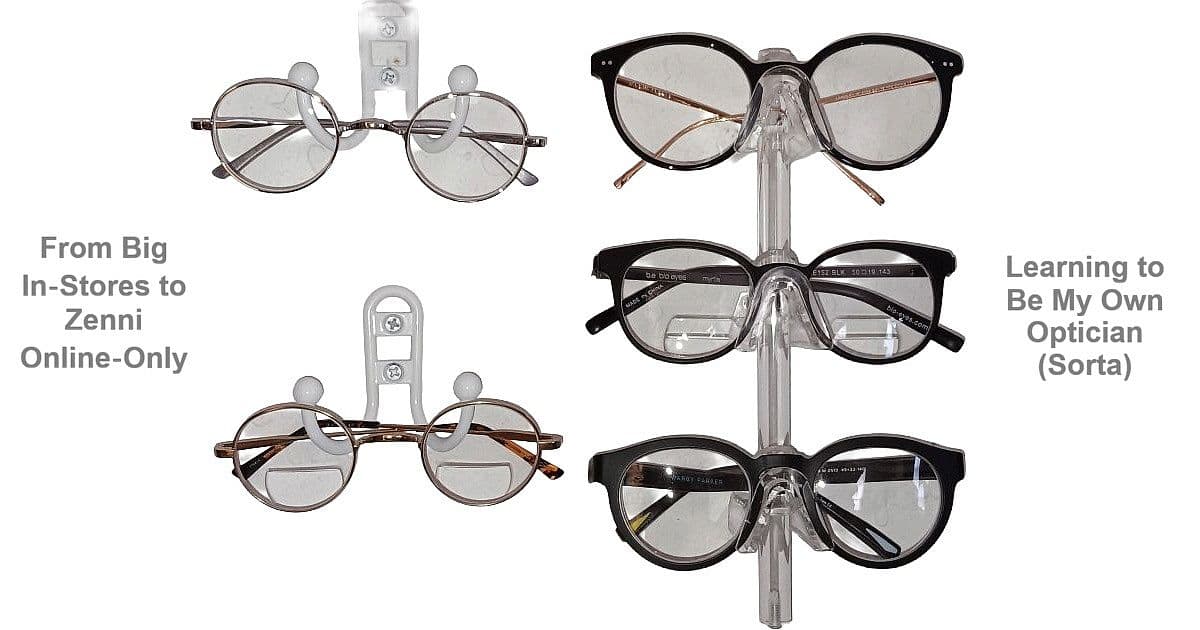
I’m not an optician, but when you start ordering glasses online, you suddenly have to pretend to be one. You’re the one picking frame size, deciding between single‑vision, bifocals, trifocals, and progressives, and hoping it all works once it lands on your face. You still need a real eye exam and a real optician for a good prescription and PD, but after that, it’s you, a website, and a credit card.
Last year I spent almost a thousand dollars on frames and lenses after cataract surgery. I wanted to celebrate finally getting it done, ditch the bare‑bones Walmart 9.99–13.99 specials, and try progressive lenses for the first time. This year I’m in the “why did I spend that much?” phase and looking hard at cheaper online options — with Zenni ending up as my main test case.
You don’t have to be an optician to order from Zenni, but you do have to act a little like one. That means knowing your prescription, getting your PD, and paying attention to frame sizes so your online‑only glasses don’t end up as an expensive mistake.
The Expensive Phase: Warby Parker and Walmart
I started with a splurge: two pairs from Warby Parker. They were expensive but discounted for two pairs, so my brain called it a “deal.” I got their main progressive lens in one pair, and the lenses were free in the second pair because those were just intermediate/computer distance. Single‑vision lenses are free with them, but progressives jump the price way up, and they don’t do the traditional lined bifocals at all. The selection of frames is great, and my in‑store optician was professional and helpful, but you definitely pay for that hand‑holding.
Then I wandered back to my old standby: Walmart Vision Center. I bought a lightweight titanium frame and had intermediate lenses put in for a smaller, rectangle, computer‑only pair. I also took the Warby Parker frame that had intermediate lenses and had Walmart put their progressive lenses in it.
On top of that, I picked up a pair of Bio Eyes Men’s BE152 Myrtle Round frames at Walmart and had trifocals added. Those Walmart progressives were a lot cheaper than Warby Parker’s and just as good for me, with one exception: no anti‑glare for watching TV, which I noticed pretty quickly.
At that point I had:
Warby Parker progressives
Warby Parker intermediate pair
Walmart intermediate titaniums
Walmart progressives in the WP frame
Walmart traditional lined trifocals
Great vision, empty wallet.
Getting Ready to Be Your Own “Sorta” Optician
If you’re going to move from in‑store to online, you have to start thinking like a DIY optician, at least a little. Here’s what I found I really needed before clicking “Add to cart”:
- A current eye exam and written prescription.
You can’t skip this part. You need an up‑to‑date prescription on paper so you can either type it in yourself or upload a clear photo of it, depending on what the online site asks for. - Your PD (pupillary distance).
You’ll probably still need an optician for that. There are two flavors:
– Single PD (binocular): one number for both eyes.
– Dual PD (monocular or “double PD”): a separate number for each eye.
Online forms will ask for one or the other, so it’s worth getting both written down. - A frame that already fits you well.
Grab a pair you like and look for the tiny numbers on the inside of the arm. They’ll look something like 44‑24‑140, which will matter in a minute. - Decide what each pair is actually for.
Don’t just pick “progressive” because it sounds fancy. For each pair, decide:
– Single‑vision distance
– Single‑vision reading
– Intermediate/computer
– Lined bifocal
– Progressive
Knowing the job of each pair keeps you from ending up with three “sort of okay for everything, great for nothing” glasses.
My Zenni Experiment
Almost a year after the in‑store splurge, I finally dipped my toes into the online pool with Zenni. I’d seen the ads before but didn’t know enough to feel comfortable ordering from them back then. Now, with a prescription in hand and a better feel for what lenses I like, it seemed like a good time to experiment.
I started with the same basic frame in two different colors and lens setups:
Gold round glasses #414414
Frames: 15.95
With lined bifocals, the total came to 49.80.Silver round glasses #414411
Frames: 15.95
With progressive lenses, the total came to 78.80.
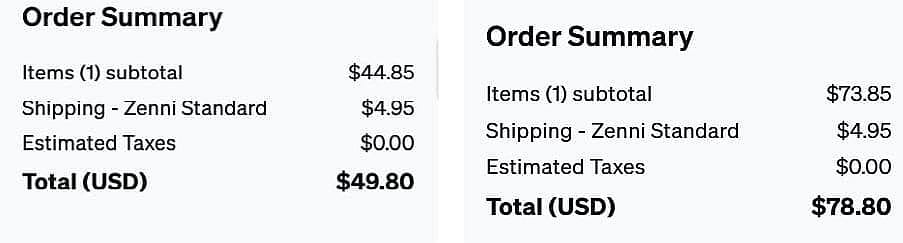
Both are small, round metal frames and use the same size numbers: 44‑24‑140.
Size Matters: What 44‑24‑140 Actually Means
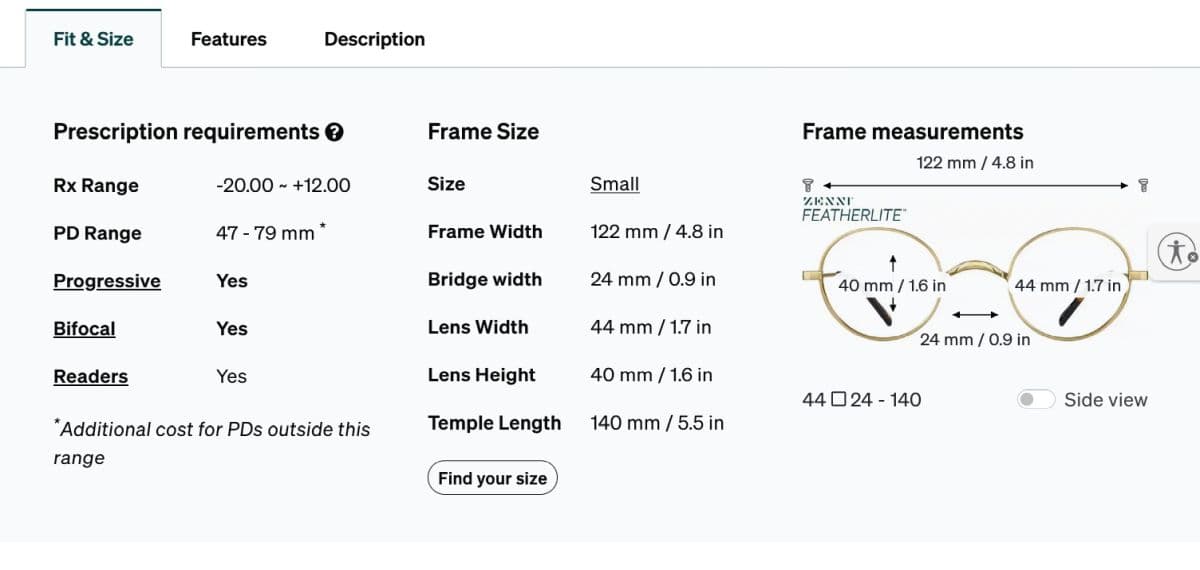
Online, you can’t try frames on, so those little numbers become a big deal. For the Zenni frames I ordered, the size is 44‑24‑140.
44 = lens width in millimeters
24 = bridge width (the part over your nose)
140 = temple length (the arms that go over your ears)
The thing I worried about most was the lens being too small for progressives. My round lenses have a lens height of 40 mm, and I was worried that wasn’t enough room for distance, mid‑range, and near zones. Turns out 40 mm is actually generous for progressives; it gives plenty of vertical space to carve out all three zones without feeling cramped. The frame gets labeled “small” mainly because the lens width is only 44 mm and the bridge is a bit wide, so it sits compactly on your face, not because the lens is too short.
The lesson there: don’t let the “small” tag scare you off if the lens height is decent. Pay attention to the actual millimeters, especially for progressives. Note: The temple arms were a little short for me, but not really noticeable to anyone else.
Warby Parker vs Walmart vs Zenni (From My Face, Not a Lab)
Here’s how they shake out in my real life:
- Warby Parker.
– Pros: Nice frames, polished in‑store experience, free single‑vision lenses, friendly optician help.
– Cons: Progressives are pricey, no traditional lined bifocals, you pay a premium for the showroom and branding. - Walmart Vision Center.
– Pros: Much cheaper progressives, option to use your own frames, traditional lined bifocals available, familiar and convenient.
– Cons: Fewer bells and whistles like anti‑glare for TV in my case, frame selection isn’t as “fun.” - Zenni (online‑only).
– Pros: Dirt‑cheap frames, lots of sizes and colors, easy to experiment with multiple pairs without needing a second mortgage.
– Cons: You are your own “sorta” optician, so if you get PD or frame size wrong, that’s on you; no one is hovering over your shoulder telling you what to pick.
What I’d Do Differently Next Time
If I could rewind to right after cataract surgery, knowing what I know now, I’d do it a little differently.
I’d still get one really dependable pair from a brick‑and‑mortar optician, just for peace of mind while my eyes were settling.
I’d skip ordering multiple expensive pairs right away and instead move my “fun” experimenting over to cheaper online frames once I knew what worked.
I’d pay more attention to lens height for progressives and less to whatever marketing name they give the lens.
And I’d make sure every pair has its job: one for computer, one for TV and distance, one for reading, instead of trying to make one magical unicorn pair do everything.
Quick Tips If You Want to Try Online
If you’re thinking about becoming your own “sorta” optician and ordering from somewhere like Zenni, here’s the short version:
- Get a current eye exam and a written prescription.
- Ask for your PD, and if possible, get both single and dual PD noted.
- Measure a pair of glasses you already like and match those numbers (width, bridge, temple).
- For progressives, check lens height, not just whether the frame is labeled “small.”
- Start with one inexpensive test pair before you go wild ordering a whole wardrobe.
Outro
In the end, I still like walking into a real shop when I need help—eyeglasses still need pro cleanings, tune‑ups, and sometimes new lenses dropped into favorite frames—but for everyday glasses, having my prescription, PD, and frame sizes means I can be my own optician just enough to let Zenni and other online‑only sellers save me a pile of money.
I had also been hunting for a small, round, all‑metal frame without nose tabs for a long time, the kind of simple wire rims John Lennon wore. When I finally found that style in my size at Zenni, it felt like checking off a decades‑old wish list item and made the whole “be my own optician” experiment a lot more fun.

Other Posts: