
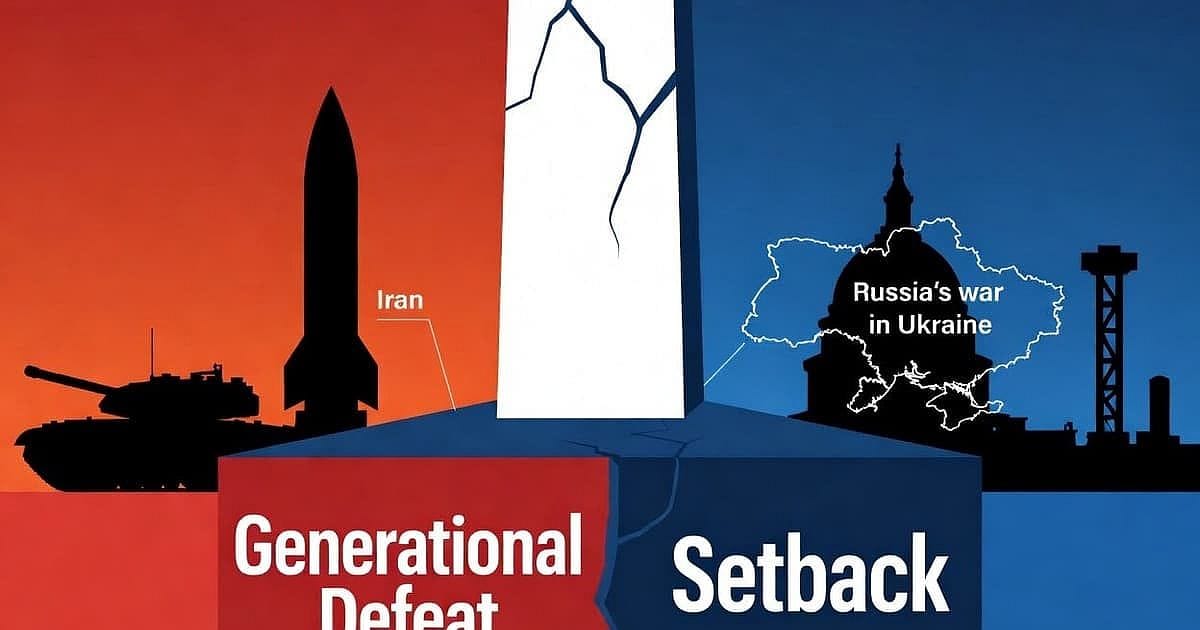
Generational Defeat vs Setback isn’t just a catchy phrase, it’s the cleanest way to describe the split-screen unfolding right now between Iran and Russia. One regime has just suffered what America’s top Middle East commander openly calls a “generational military defeat.” The other is bleeding its army and its future away in a grinding war it can’t really win, even as Donald Trump keeps trying to pretend that the loser isn’t the side he effectively backed.
Once you look at this Generational Defeat vs Setback contrast with clear eyes, Trump’s choices on Ukraine and Iran stop looking like “tough deals” and start looking like terrible judgment. Iran’s ability to project conventional military power has been dismantled in weeks, largely by Israel with U.S. backing. Russia, meanwhile, has suffered a generational military setback in Ukraine: catastrophic casualties, burned-out armor, and decades of modernization wiped out, even as Trump spent years warning that Ukraine couldn’t win and shouldn’t even try.
Iran’s Generational Military Defeat
The U.S. commander for the Middle East didn’t mince words: Iran, he said, has suffered a “generational military defeat.” In plain terms, that means Iran’s conventional ability to launch large-scale attacks beyond its borders has been smashed, not chipped away. Missile fields, drone factories, naval assets, air defenses, and key pieces of its military-industrial backbone have been hit so hard that rebuilding will take decades, not years.
Israel did a lot of the heavy lifting to make that possible. Precision strikes, deep intelligence on Iranian networks, and a long memory of how Tehran moves weapons and proxies all came together in a way Washington doesn’t always manage on its own. When the dust settles, the map will show the United States as the senior partner, but the fingerprints on many of the most important blows will be Israeli.
That’s what a generational military defeat looks like: the house is still standing, the regime is still talking, but the core of its power projection has been turned into rubble and spare parts. Tehran can still cause trouble with proxies and terrorism, but its main military tools have been yanked out of its hands in something like real time. It bragged for years that it could surround Israel and threaten U.S. bases; now it has to explain to its own people why so much of that hardware is suddenly scrap.
Russia’s Generational Setback in Ukraine
Russia’s story is different. No one rolled tanks into Moscow. No one bombed out its main defense plants in a 38‑day campaign. On paper, Russia still has an army in the field and territory under occupation. But look under the hood, and you see a generational setback unfolding in slow motion.
By early 2026, Russia has burned through much of the professional force that invaded Ukraine in 2022. Casualty estimates run into seven figures when you add up killed, wounded, and missing. Tank fleets that once symbolized Soviet glory are now a mix of modern hulls and museum pieces dragged out of long-term storage. The glittering modernization projects Kremlin propagandists once bragged about have been pushed back by a decade or more.
This is what “setback” really means in this context: Russia can still fight, but at the cost of its future. Demographic decline was already baked into the cake; now whole age cohorts of young men are being chewed up in trench warfare. Sanctions and brain drain quietly hollow out the industrial and technological base. Moscow can still take a village or two with meat‑grinder tactics, but every meter of advance is paid for with blood it can’t easily replace.
So no, Russia has not suffered the kind of sudden, concentrated generational military defeat that Iran just did. Instead, it has locked itself into a war that shaves years off its military, economic, and human potential every single day. That’s a generational setback: the future gets dimmer, even as the regime insists it is “winning.” Now even Moscow and Kyiv admit that an end to the Ukraine war may be close.
Trump’s Terrible Bet on Putin
Into this picture walks Donald Trump, the self-styled master of deals and instincts. Trump loves to talk about “ending the war” in Ukraine as if it were a quick TV deal he can close in 24 hours. On Ukraine, his public posture has been strangely consistent: avoid saying he wants Ukraine to win, talk vaguely about “stopping the killing,” and lean on Kyiv to accept some kind of land‑for‑peace deal that would reward Russian aggression. He has repeatedly painted Ukraine as the weak hand at the table, the side that should fold.
The irony is that reality never fully matched Trump’s script. Ukraine, with help from the U.S. and Europe, turned back Russia’s initial blitz toward Kyiv, retook swaths of occupied land, and forced Moscow into the very grinding war that is now hollowing out Russia’s future. The side Trump treated as hopeless and expendable became the side that inflicted a generational setback on his favored strongman in the Kremlin.
The same pattern shows up when you put Iran into the frame. Trump’s own team is now rushing onto TV to call the Iran war a “historic” and “overwhelming” Trump victory, even though it was weeks of U.S.–Israeli bombing, improvised decisions, and Israeli persistence on the ground that actually shredded Iran’s conventional power.
Trump’s record on Iran still looks like a half‑war: maximum threats, some sharp blows, constant warnings and extensions of grace, but no clear strategic endgame while Tehran played tit‑for‑tat around the region. In practice, it was that combination of Israeli persistence and later U.S. military overmatch—not some coherent Trump doctrine—that produced something close to a real generational defeat for Iran.
In other words, Trump has managed to position himself on the wrong side of both arcs: skeptical of the partner (Ukraine) that has done enormous damage to Russia’s war machine, and eager to take credit for an Iran outcome largely delivered by others. That’s the Generational Defeat vs Setback reality Trump keeps dodging.
The Generational Defeat vs Setback Lesson for Trump
This is where Generational Defeat vs Setback becomes more than a clever label and turns into a test of judgment. Iran’s generational defeat shows what happens when a hostile regime’s ability to project power is dismantled in a concentrated campaign. Russia’s generational setback shows what happens when a revanchist power walks into a war it can’t win cleanly and slowly saws off its own limbs.
Trump’s instincts put him closer to Russia than to Ukraine, closer to deal‑making with strongmen than to backing allies who are actually paying the price to push those strongmen back. He positioned himself emotionally and politically with the country now suffering a generational setback, not with the country forcing that setback onto the battlefield. And when it comes to Iran, he is now watching a generational defeat unfold that he talks about as his victory, even as he struggles to turn threats and deadlines into a real, finished outcome.
American voters don’t have to become armchair generals to see what this says about leadership. A real leader should be able to tell the difference between a regime that just lost a generation of power and a regime that is slowly throwing one away. A real leader should understand that siding with the people resisting aggression is not weakness, and that mocking Ukraine or hedging on its victory while Russia bleeds out is not “strength,” it’s confusion.
In the end, Generational Defeat vs Setback is also a choice about what kind of country the United States wants to be. Do we stand with the allies who helped impose a generational military setback on Russia and a generational military defeat on Iran, or do we follow a leader whose worst instincts keep pulling him toward the losing side of history? That’s the question that will still be hanging in the air long after the current headlines fade.
Outro: Generational Defeat vs Setback, in Two Sentences
In the end, Iran has suffered a Generational Defeat, while Russia’s war in Ukraine remains a painful but still limited setback. That Generational Defeat vs Setback gap is what Americans need to see clearly before they choose which story to believe.
For a very different take on what this Iran war says about Generational Defeat vs Setback, see this New Neo post: Iran War: wanting the Promised Land without the Wilderness.